Can a Smile Makeover Fix Crooked Teeth Without Braces Safely?
Can a smile makeover fix crooked teeth without braces? Discover safe cosmetic dentistry options to straighten your smile. Schedule your visit in Long Beach today!
Read More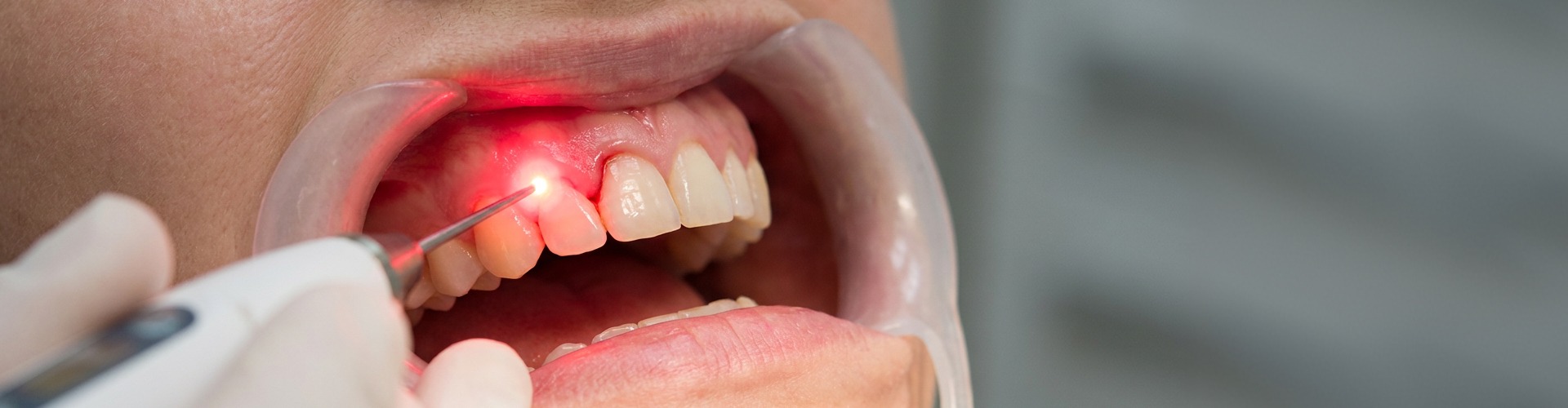
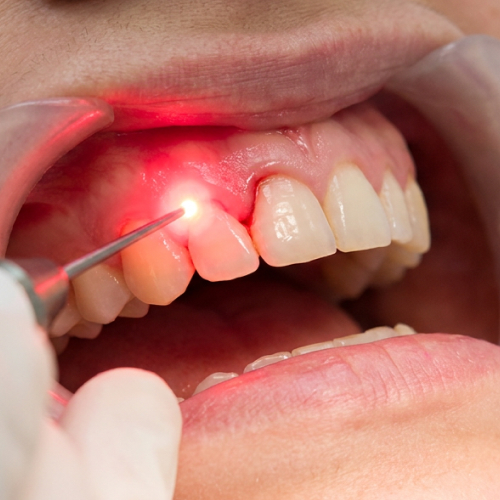
Laser treatment — specifically the LANAP protocol — can halt gum disease progression and stimulate genuine bone and ligament regeneration, but it cannot cure gum disease in the way antibiotics cure an infection. Understanding what the procedure actually does, including some counterintuitive healing effects, helps you make a smarter decision for your long-term oral health.
For Long Beach-area patients, one of the most alarming experiences patients report after LANAP is looking in the mirror and seeing longer teeth, wider gaps, and new "black triangles" between teeth — then assuming the laser destroyed healthy tissue. Online forums are full of panicked posts from people convinced their gums receded because of surgery.
Here's the physiological reality: diseased gums are chronically swollen. Infection causes significant inflammation, which puffs the tissue outward, masking the underlying bone and attachment loss that has already occurred. When LANAP's Nd:YAG laser successfully eliminates the bacteria driving that infection, the inflammation subsides. The gums shrink — not because they were damaged, but because they're finally healthy and tight again.
What's now visible — the black triangles, the exposed roots — was already there. The disease had already caused that destruction. The swelling was simply hiding it.
According to NIDCR, gum disease progressively destroys the tissues holding teeth in place, and much of that structural damage occurs silently before patients notice visible changes.
This distinction matters enormously. If you mistake healing for failure and abandon the post-operative protocol, you lose the window for true regeneration. For many patients, the visible gaps can later be addressed cosmetically through bonding or Bioclear matrix procedures once healing is complete — typically several months post-surgery. Early-stage gum disease is far easier to treat before it progresses to the point of requiring surgical intervention.
Many dental offices advertise "laser gum treatment" — but not all laser procedures are equal, and the difference affects your clinical outcome significantly.
True LANAP (Laser-Assisted New Attachment Procedure) can only be performed using one specific device: the PerioLase MVP-7, an Nd:YAG laser operating at 1,064 nm. This is the only laser with FDA clearance for true periodontal regeneration — meaning the documented ability to stimulate regrowth of bone, cementum, and periodontal ligament. Research published in PMC traces LANAP's development directly to this specific wavelength and protocol, noting that histologic evidence of regeneration was established using the PerioLase MVP-7 exclusively.
What many offices perform instead is Laser-Assisted Periodontal Therapy (LAPT) using diode lasers — lower-wavelength devices primarily used for pocket disinfection and bacterial reduction. Diode lasers are clinically useful. A Healthline overview of laser gum surgery notes that lasers can remove diseased tissue, kill bacteria, and sterilize periodontal pockets. But disinfection is not regeneration.
When evaluating providers, ask directly: "Are you using a diode laser for pocket disinfection, or are you certified in the patented LANAP protocol using the PerioLase MVP-7?" Certified LANAP providers require specific hands-on training beyond standard dental licensure. If the answer is vague, you may be paying for a premium procedure while receiving a standard one.
Patients researching LANAP focus almost entirely on the laser itself. What most don't realize is that the official LANAP protocol mandates occlusal adjustment — the dentist grinds down specific teeth to balance how your bite forces are distributed.
This isn't optional. It's mechanically critical.
LANAP's regenerative capacity depends on a stable fibrin clot forming between the cleaned root surface and the surrounding gum tissue. This clot acts as a biological scaffold, allowing new bone, cementum, and periodontal ligament to grow. If any tooth in the treated area experiences excessive force when biting or chewing — called occlusal trauma — the micro-movements repeatedly tear that clot before it can stabilize. Regeneration becomes impossible.
WebMD's overview of laser dentistry notes that laser procedures still require complementary techniques to achieve optimal outcomes — and bite balancing is exactly that kind of essential complement to the laser work itself.
Patients sometimes resist occlusal adjustment because it involves permanently altering tooth structure. But skipping it undermines the entire purpose of the surgery. In cases where a tooth cannot be saved even with treatment, a tooth extraction may ultimately be necessary to protect surrounding teeth and bone.
So — can laser treatment cure gum disease? The honest answer is nuanced.
LANAP can eliminate the bacterial infection, reduce pocket depths, and in documented cases stimulate true regeneration of lost bone and periodontal ligament. A Healthline article on receding gums notes that gum tissue doesn't regenerate the way skin does — meaning recession itself cannot be fully reversed. But LANAP targets deeper structures: the bone and ligament, not just the surface gum tissue.
What laser treatment cannot do is eliminate the underlying susceptibility to gum disease. Patients who are genetically predisposed, who smoke, or who have systemic conditions like diabetes face ongoing risk regardless of how successful the initial procedure is. Long-term periodontal maintenance — including regular cleaning and exam appointments, monitoring pocket depths, and ongoing hygiene — remains non-negotiable after any gum treatment, laser or otherwise.
The disadvantages of laser gum surgery are real and worth acknowledging: it requires highly trained providers, the specific equipment is expensive and not universally available, and not every case is appropriate for a laser-only approach. Some severe presentations still require traditional flap surgery. Results also depend heavily on patient compliance during healing — particularly following the bite adjustment protocol and avoiding anything that disrupts clot formation in the weeks after surgery.
Used correctly, by a properly certified provider, LANAP is one of the most effective tools available for moderate to severe periodontitis. Used incorrectly — or confused with a basic diode disinfection — it falls well short of its potential. In some cases, an endodontic root canal may also be needed alongside periodontal treatment when infection has spread to the tooth's inner structures.
If you're dealing with a dental emergency related to gum disease or want to understand whether laser treatment is right for your situation, Long Beach Family Dentist is here to help. Serving the Long Beach community, our team can evaluate your periodontal health, explain exactly which treatments we offer, and help you ask the right questions before committing to any procedure. Schedule a consultation to get clear, honest answers.
Medical disclaimer: This article is intended for informational purposes only and does not constitute medical or dental advice. Always consult a licensed dental professional for diagnosis and treatment recommendations specific to your situation.
Fresh news from the dental world


Mon 8AM - 5PM
Tue 8AM - 5PM
Wed-Thu 8AM - 5PM
Fri 8AM - 5PM
Sat 9AM - 3PM
Sun Closed
Check out what our patients are saying in Long Beach, CA...


“Clean and friendly...”
Very clean and friendly crew. I really enjoyed myself.

“A positive experience...”
Very clean and organized office! Entire staff was pleasant and friendly, and seems interested in ensuring I had a positive experience. Will definitely return! Affordable rates.

“My favorite dentist...”
The service here is amazing and they make you feel comfortable. I'm one of those people that hates to go to the dentist and the dentists that I went to in the past were not that great with service. Overall I found my favorite dentist service now at Long Beach Family Dentist.

“Answers any questions...”
I been a patient here for over twelve years. Andrea greeted me and got my folder set up. Toni is very friendly and answers any questions you have promptly, when I always come in she greets you with a smile and makes your appointment enjoyable. Today Jovani and Dr. Joan made this experience great. I recommend this dentist for new patients.
“Clean and friendly...”
Very clean and friendly crew. I really enjoyed myself.
“A positive experience...”
Very clean and organized office! Entire staff was pleasant and friendly, and seems interested in ensuring I had a positive experience. Will definitely return! Affordable rates.
Check out our accreditations, sources, and relationships in the wide world of dentistry...


Check us out and follow our Long Beach, CA practice on social media...