Can a Smile Makeover Fix Crooked Teeth Without Braces Safely?
Can a smile makeover fix crooked teeth without braces? Discover safe cosmetic dentistry options to straighten your smile. Schedule your visit in Long Beach today!
Read More
Gum reshaping procedures vary widely in complexity, and what you actually pay depends heavily on how your dentist codes the procedure for insurance — not just how many teeth are involved. Understanding billing codes and procedure types before your appointment can mean the difference between full out-of-pocket costs and significant insurance coverage.
For Long Beach-area patients, most patients searching for gingivectomy costs get frustratingly vague answers. The real answer isn't a number — it's a code.
Dentists submit claims using Current Dental Terminology (CDT) codes, and the specific code chosen determines whether your insurance pays anything at all. There are three codes that matter here:
If your dentist submits D4212, most insurance plans pay exactly nothing. If the procedure is clinically justified — say, treating drug-induced gingival hyperplasia, reducing pathological pockets, or addressing gum disease — and coded as D4210 or D4211, many plans cover 50% to 80% of the allowed amount.
Here's the key question to ask before treatment: "Can this procedure be clinically documented as therapeutic rather than cosmetic?"
In many cases, the same physical tissue removal qualifies as therapeutic. According to WebMD, gum contouring procedures not considered cosmetic include trimming overgrown tissue that has covered part of the tooth crown and adding gum tissue when recession has occurred. If your situation meets that clinical threshold, your dentist may be able to justify a therapeutic code.
When you receive your pre-treatment estimate, look at the CDT code listed. If it reads D4212, ask directly: "Does my gum condition have any clinical findings — pocket depth, hyperplasia, recession — that would support a therapeutic code instead?"
Even when insurance isn't involved, how dentists calculate the total matters enormously. There are two pricing structures in use:
Per-tooth billing applies when you're having one to three teeth treated in the same quadrant (one section of your mouth). Each tooth is billed individually.
Per-quadrant billing kicks in at four or more teeth in the same section. Instead of multiplying the per-tooth rate by four, five, or six, the dentist bills a flat quadrant rate — which is almost always more economical per tooth.
This creates what billing coordinators call the 4-tooth threshold. If you need work on three teeth in one area, you're paying per-tooth rates. But if a fourth tooth in that same quadrant also has a clinical need — even a minor one — adding it to the procedure shifts the billing to a flat quadrant code.
Before your procedure, ask your billing coordinator directly: "If I include a fourth tooth in this quadrant, does billing shift from per-tooth to a flat quadrant code, and does that lower my total?"
A Healthline overview of gum contouring notes the procedure is typically completed in a single visit — meaning there's no reason to split treatment unnecessarily across appointments when consolidating teeth in one quadrant could reduce your total obligation.
This is the part most cost-focused articles skip entirely — and it's the most expensive mistake patients make.
A basic gingivectomy cuts away excess gum tissue. It's relatively straightforward. But if the dentist removes tissue without measuring the distance between the cut margin and the underlying bone, something predictable happens: the gum grows back.
This isn't random. It's anatomy. The body maintains what's called biologic width — approximately 2mm of attachment between the base of the gum sulcus and the alveolar bone crest. If a gingivectomy cuts into that zone without addressing the bone level, your immune system treats it as a violation and rebuilds the tissue to restore that protective distance.
Research published in PMC on crown lengthening confirms that when the gingival excision to the desired clinical crown length would expose the alveolar crest, staging the procedures and including osseous contouring is necessary — otherwise the biologic width is violated and tissue regrowth is expected.
The more complex procedure — osseous crown lengthening — involves a small amount of bone reshaping in addition to tissue removal. It preserves biologic width. It's more involved upfront. But it prevents the relapse that turns one procedure into two.
If a dentist recommends a gingivectomy for a gummy smile or short-looking teeth, ask: "Will this require bone contouring to maintain biologic width, or is there enough soft tissue depth to avoid that?" If the answer is no bone work needed, great. If the dentist hasn't measured — that's worth a follow-up conversation.
According to Healthline's coverage of gummy smile treatments, results from gingivectomy are likely to be long-lasting or permanent — but that durability depends entirely on whether the procedure was planned with the underlying bone anatomy in mind.
Gum contouring, gingivectomy, and gingivoplasty are related but distinct terms. Here's how they differ in practice:
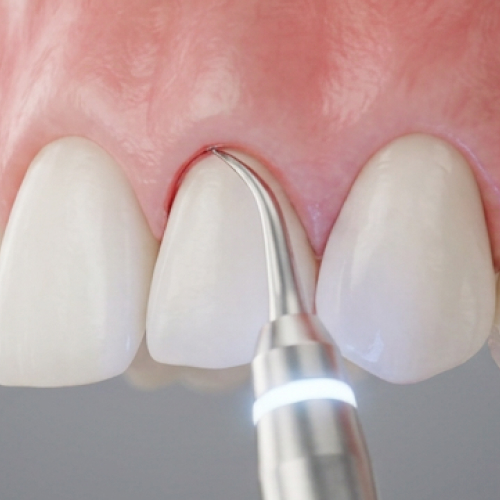
Gingivectomy is the removal of gum tissue — used both to treat periodontal disease and to address cosmetic concerns like a gummy smile. Patients interested in improving their overall smile appearance may also want to explore aesthetic dentistry options that complement gum reshaping.
Gingivoplasty is the reshaping of gum tissue to create a more natural contour, often performed after gingivectomy to smooth and sculpt the result.
Gum contouring is the broader cosmetic term that typically encompasses both, focused on improving the appearance of the gumline. Some patients combine this with porcelain veneers for a complete smile transformation.
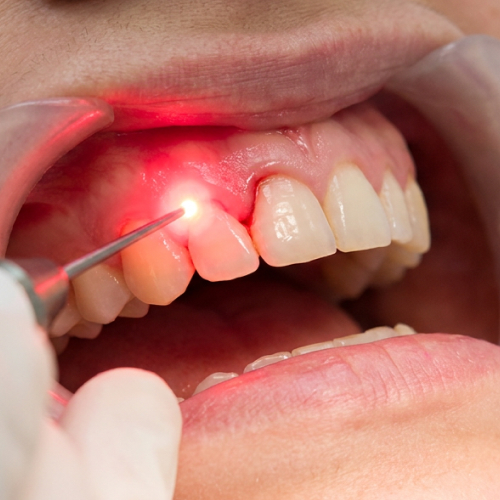
As WebMD notes, general dentists and periodontists can both perform these procedures. Before scheduling, it's worth asking specifically about the provider's experience with laser-assisted techniques — diode lasers offer improved hemostasis, reduced post-operative pain, and faster healing compared to traditional scalpel methods, according to PMC research on laser-assisted gingivectomy.
Most procedures are completed under local anesthesia in a single office visit. Recovery typically involves a few days of soft foods and mild discomfort. The gumline continues to refine over several weeks as swelling resolves and tissue settles.
Candidacy depends on your gum health baseline. Patients with active periodontal disease are usually treated for the infection first before any reshaping is considered. Maintaining a healthy baseline with regular cleaning and exam appointments is an important part of that process.
If you're in the Long Beach area and wondering whether gum contouring, gingivectomy, or gingivoplasty is right for you, the best next step is a clinical evaluation — not a price search. Procedure type, billing codes, and whether insurance applies all depend on your individual anatomy and documented clinical findings.
Long Beach Family Dentist serves patients throughout Long Beach, California with comprehensive cosmetic and periodontal services, including dental implants and other restorative solutions. Contact us to schedule a consultation and get a clear picture of what your gumline treatment would actually involve — including how it would be coded and billed.
Medical disclaimer: This article is for informational purposes only and does not constitute dental or medical advice. Individual treatment needs vary. Consult a licensed dental professional for diagnosis and personalized treatment recommendations.
Fresh news from the dental world




Mon 8AM - 5PM
Tue 8AM - 5PM
Wed-Thu 8AM - 5PM
Fri 8AM - 5PM
Sat 9AM - 3PM
Sun Closed
Check out what our patients are saying in Long Beach, CA...


“Clean and friendly...”
Very clean and friendly crew. I really enjoyed myself.

“A positive experience...”
Very clean and organized office! Entire staff was pleasant and friendly, and seems interested in ensuring I had a positive experience. Will definitely return! Affordable rates.

“My favorite dentist...”
The service here is amazing and they make you feel comfortable. I'm one of those people that hates to go to the dentist and the dentists that I went to in the past were not that great with service. Overall I found my favorite dentist service now at Long Beach Family Dentist.

“Answers any questions...”
I been a patient here for over twelve years. Andrea greeted me and got my folder set up. Toni is very friendly and answers any questions you have promptly, when I always come in she greets you with a smile and makes your appointment enjoyable. Today Jovani and Dr. Joan made this experience great. I recommend this dentist for new patients.
“Clean and friendly...”
Very clean and friendly crew. I really enjoyed myself.
“A positive experience...”
Very clean and organized office! Entire staff was pleasant and friendly, and seems interested in ensuring I had a positive experience. Will definitely return! Affordable rates.
Check out our accreditations, sources, and relationships in the wide world of dentistry...


Check us out and follow our Long Beach, CA practice on social media...