What Patients Ask Before Getting Veneers: Stains, Nightguards, and Whitening
Do veneers stain? Do you need a nightguard? Learn the facts about porcelain veneers and whitening. Schedule your consultation at Long Beach Family Dentist now!
Read More
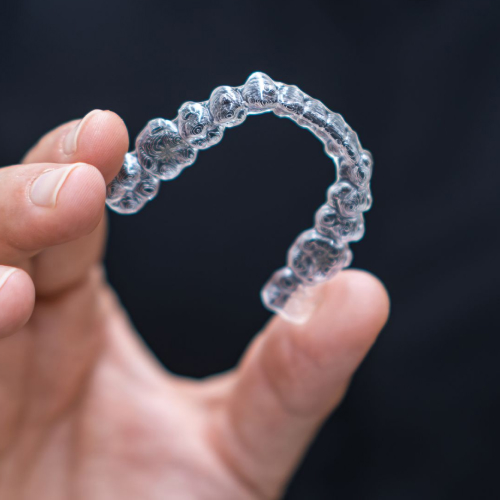
Clear aligners, otherwise known as invisible aligners or Invisalign, are a kind of orthodontic treatment that is used currently to correct crooked teeth. If an orthodontic correction of a person’s teeth should be of interest to them, but the fact that they have to wear braces or metallic apparatus bothers them, clear aligners might be the ideal result for them. This is because it is aesthetically appealing as it is unnoticeable on sight and is a removable prosthesis, while metal braces are designed according to convenience and flexibility. Are Clear Aligners More Suitable Than Braces? Clear aligners could be compared with conventional braces. In comparison, clear aligners are small guides made with a transparent material, therefore, making them virtually invisible. They are designed by high technology computer science, so the clear aligners are custom-made for the patient’s mouth. Because they are smooth, clear aligners, they do not irritate the mucous membrane of your mouth, which can be one of the main sources of discomfort in conventional orthodontic systems. The clear aligner trays can be removed at any time during the day, making them practical for mealtimes. Also, for their upkeep, each tray must be worn for a period of two weeks, allowing a gradual movement of the teeth. The length of the treatment can vary from one person to the next depending on the condition of the teeth and on the extent of the work to be done. In most cases, the treatment does not exceed a year.
Reasons For Getting Clear Aligners Clear aligners can treat various issues, which include the following: -Crowding, when teeth overlap one another -Overbites, when the lower arch teeth are behind the upper teeth -Underbites, when lower teeth overlap the top front teeth -Diastema, when there are gaps between the teeth -Open bites, when the front teeth are in a slanting position and do not touch each other, which leads to an open mouth -Misaligned primary (deciduous) teeth, used during phase I orthodontic treatment to make room for existing baby teeth and developing permanent teeth In-Office Clear Aligners Vs At-Home Aligners There are two types of clear aligners. They are as follows: 1. In-office aligners: They are commonly called clear aligners or Invisalign. They are the most well-known option because they have been around the longest. The patient has to visit a licensed Invisalign doctor to receive these aligners, and the treatment process is more intensive. 2. At-home aligners: They are also called direct-to-consumer aligners and are cheaper than in-office aligners. Treatment is completed remotely, so the patient will never visit a dentist or an orthodontist for check-ups. A medical-grade, BPA-free plastic is used for both in-office and at-home aligners. Some clear aligners do not touch the gums at all. They are trimmed to comfortably sit along the gum line in a scalloped fashion. As a result, they are less irritating and even more discreet. Other at-home aligners are not trimmed along the gum line. Instead, they partially cover the gums and may cause more irritation in the beginning stages. The discomfort is typically minor. Direct-to-consumer aligners can only treat minor cases of teeth misalignment. An example would be a few crooked teeth or a small gap in between them. How Do Clear Aligners Work? The clear aligner treatment process involves the following steps: 1. Custom Treatment Plan First, the patient visits an orthodontist for a consultation. During the consultation, the dentist will examine the patient’s teeth and take a precise digital scan of the oral cavity. Then a custom treatment plan is made. The patient will then receive a digital preview of their new smile before the clear aligners are created. In some cases, clear aligner brands also allow patients to mail in molds of their teeth instead of going to an orthodontist. 2. Aligner Preparation After the teeth impressions are made, the custom treatment plan will be created using 3D technology. When the digital models are approved, they are transferred to a production facility, where they are made. From here on out, the treatment process begins. 3. Aligners Daily Upkeep The patient has to change out the clear aligner trays every 1 to 3 weeks. For effective teeth straightening, the patient must wear them for about 20 to 22 hours a day. Multiple clear aligners are used because a single aligner is only capable of moving teeth slightly (1 mm or less). Some brands only have to be worn for 10 hours a day. Each set of aligners gradually moves the teeth into the proper position. This usually takes between three and twenty-four months. 4. After Treatment After treatment is complete, a custom clear aligner retainer is made from a mold of the patient’s newly straightened teeth. To prevent malocclusion from recurring over time, retainers should be worn while sleeping every night.
To sum up: Clear aligners are invisible custom-made trays that are made according to the fitting of the patient’s tooth alignment. They are a kind of orthodontic treatment that people prefer over the traditional metallic braces, mostly due to esthetic reasons. They are used nowadays to correct crooked teeth, misalignment of teeth, underbites, overbites, and crowding of the teeth. They are of two types, professional clear aligners and take home clear aligners. They are worth the money because they satisfy every aspect of the patient’s concerns. FAQs Is Invisalign Worth The Money? Yes, Invisalign is surely worth the money. In comparison to the traditional braces, clear aligners are invisible, and the treatment time lasts for only one year. While the patient is wearing clear aligners, there are no food or drink restrictions, and brushing is also easier. Lastly, they are aesthetically pleasing. What Are The Pros And Cons Of Invisalign? The pros are that they are invisible on sight and thus are aesthetically appealing. They are easily removable, which benefits during mealtimes. The cons of clear aligners are that they are quite expensive. They are broken easily, so more investment and time are spent on their reconstruction. Do Aligners Work As Good As Braces? Depending on the patient’s concerns, clear aligners may not be able to fix every problem. Therefore, the person may end up spending more money with worse results than if they had chosen traditional braces. Clear aligners and traditional braces are both great for crooked teeth, overbite, gaps, and crowding.
Fresh news from the dental world





Mon 8AM - 5PM
Tue 8AM - 5PM
Wed-Thu 8AM - 5PM
Fri 8AM - 5PM
Sat 9AM - 3PM
Sun Closed
Check out what our patients are saying in Long Beach, CA...


“Answers any questions...”
I been a patient here for over twelve years. Andrea greeted me and got my folder set up. Toni is very friendly and answers any questions you have promptly, when I always come in she greets you with a smile and makes your appointment enjoyable. Today Jovani and Dr. Joan made this experience great. I recommend this dentist for new patients.

“Clean and friendly...”
Very clean and friendly crew. I really enjoyed myself.

“A positive experience...”
Very clean and organized office! Entire staff was pleasant and friendly, and seems interested in ensuring I had a positive experience. Will definitely return! Affordable rates.

“My favorite dentist...”
The service here is amazing and they make you feel comfortable. I'm one of those people that hates to go to the dentist and the dentists that I went to in the past were not that great with service. Overall I found my favorite dentist service now at Long Beach Family Dentist.
“Answers any questions...”
I been a patient here for over twelve years. Andrea greeted me and got my folder set up. Toni is very friendly and answers any questions you have promptly, when I always come in she greets you with a smile and makes your appointment enjoyable. Today Jovani and Dr. Joan made this experience great. I recommend this dentist for new patients.
“Clean and friendly...”
Very clean and friendly crew. I really enjoyed myself.
Check out our accreditations, sources, and relationships in the wide world of dentistry...


Check us out and follow our Long Beach, CA practice on social media...